/work

Nought.digital

Delivery Practice AI Engineering Systems Active

AI engineering & delivery practice

nought.digital

Problem

Teams struggle to ship AI-enabled systems quickly without losing control. Projects stall in discovery, prototypes don't harden into production, and AI work becomes fragile, opaque, or over-engineered.

Approach

Built Nought.digital as an outcome-driven delivery practice with a fixed execution model.

  • Defined a clear end-to-end process (Outline → Research → Build → Integrate → Test)
  • Focus on shipping real systems, not decks or demos
  • AI used as an accelerator, not a black box
  • Emphasis on observability, guardrails, and human-in-the-loop workflows
  • Delivery scoped by outcomes, not hours
  • Designed to drop into teams, unblock delivery, and leave behind production-ready systems.

Outcome

  • Complex projects delivered in weeks instead of months
  • Clear ownership, predictable delivery, and fewer rewrites
  • AI systems that teams can understand, control, and extend
  • Repeatable framework now used across multiple real projects
Quiteful

SaaS Paid

SaaS for compliant, real-time allergen menus

quiteful.com

Problem

Food businesses struggle to keep allergen information accurate, compliant, and up to date. Menus are static, changes are manual, and mistakes carry real legal and health risk. Existing solutions are slow to update, hard to embed, or require full site rebuilds.

Approach

Built a menu management SaaS focused on accuracy, speed, and compliance.

  • Structured ingredient and allergen model (14 UK allergens + dietary tags)
  • Real-time menu updates without redeploys
  • Embeddable menus, QR codes, and WordPress plugin
  • Developer API for custom integrations
  • Optional AI ingredient spotting to flag hidden allergens
  • Clean, minimal UI focused on clarity for staff and customers
  • Designed as a proper product: multi-tenant, API-first, and deployable anywhere.

Outcome

  • Menus can be updated instantly across web, QR, and embeds
  • Reduced risk of allergen errors through structured data and validation
  • Faster onboarding for small food businesses (minutes, not days)
  • Clear compliance story without bloated CMS workflows
  • Production-ready SaaS with pricing, auth, and integrations

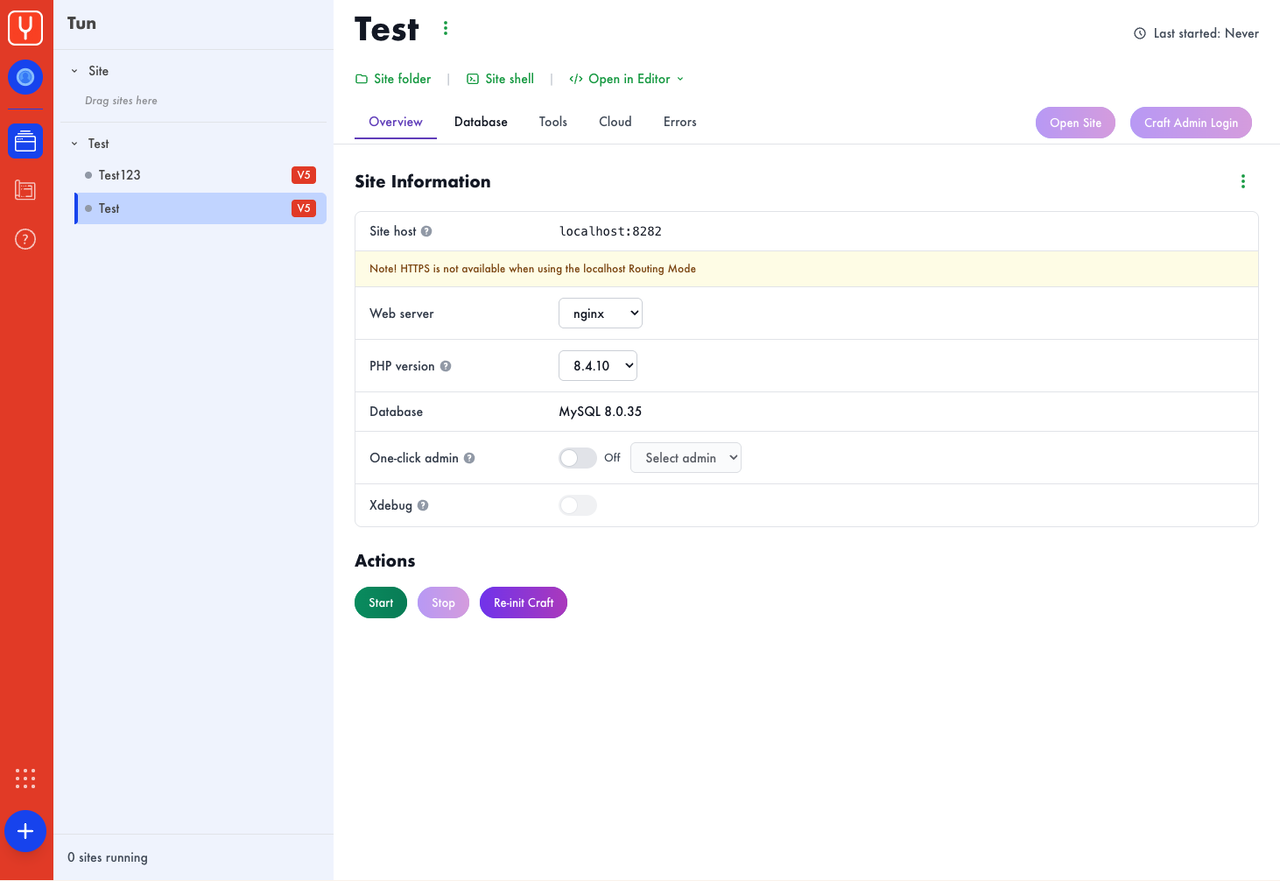
Crafttun

Desktop App

Local Craft CMS development environment

crafttun.com

Problem

Craft CMS developers had no polished, Craft-aware local development tool. Setups were manual, inconsistent across teams, Docker configs were hand-rolled, onboarding was slow, and "works on my machine" was the norm.

Approach

Built a dedicated desktop application for Craft CMS development, designed around reproducibility and developer experience.

Key decisions:

  • Craft-aware project detection and versioning (Craft 3/4/5)
  • Opinionated defaults over endless configuration
  • Blueprint system to make environments reproducible and shareable
  • Container backend abstraction (Colima, Docker)
  • Desktop UI backed by a Go daemon with a clean HTTP API boundary
  • Focused on DX first, not just container orchestration.

Outcome

  • Local Craft environments spin up in minutes instead of hours
  • Teams get consistent, repeatable environments via blueprints
  • Local → Craft Cloud workflow unified in a single tool
  • Mac-only native app to start, with stable performance and predictable setups

ConjureWP

Plugin Freemium

WordPress onboarding & setup framework

conjurewp.site

Problem

WordPress onboarding tools like MerlinWP are theme-bound, brittle, and poorly suited to modern productised workflows. Setup logic lives in themes, making it hard to reuse, version, test, or maintain — especially for agencies and SaaS-style WordPress products.

Approach

Built a plugin-first onboarding framework that decouples setup flows from themes entirely.

  • Plugin-based architecture instead of theme drop-ins
  • Guided, multi-step setup wizard reusable across projects
  • Works with any theme or page builder
  • Designed for agencies, product teams, and support workflows
  • Clean extension points for custom steps, logic, and validation
  • Licensing model aligned with real-world usage (personal, agency, unlimited)
  • Focused on separation of concerns, reusability, and long-term maintainability.

Outcome

  • Onboarding logic becomes reusable, testable, and upgradable
  • Faster project setup without locking behaviour into themes
  • Cleaner handover from build → support teams
  • Enables SaaS-style WordPress products with predictable setup flows
  • Production-ready plugin with pricing, docs, and real-world use cases

WordPress Pest Testing Framework

FREE

Modern testing framework for WordPress

github.com/JakeHenshall/pest-plugin-wordpress

Problem

WordPress testing is slow, brittle, and hostile to modern workflows. PHPUnit boilerplate, unclear setup, and poor DX mean many teams either avoid tests entirely or maintain fragile, hard-to-read test suites.

Approach

Built a Pest-first testing framework for WordPress that brings modern, expressive testing patterns into a legacy ecosystem without breaking compatibility.

  • Native Pest integration tailored for WordPress
  • Clean abstractions over WP bootstrap, factories, and globals
  • Sensible defaults to reduce setup friction
  • CI-friendly configuration for GitHub Actions and GitLab
  • Extensive documentation and real-world testing examples (WooCommerce, ACF, roles, caching, background jobs)
  • Focused on clarity, speed, and developer confidence, not just test coverage.

Outcome

  • WordPress tests become readable, concise, and maintainable
  • Faster test authoring with significantly less boilerplate
  • Enables teams to adopt modern testing without rewriting their stack
  • Improved confidence when refactoring plugins and core logic
  • Open-source framework actively usable in real projects

WP-RAG

Product WordPress Search AI-Assisted

Semantic search & retrieval infrastructure for WordPress

Problem

WordPress search is keyword-based, brittle, and poorly suited to large or content-heavy sites. Important information is hard to find, relevance is low, and extending search quality requires complex custom work.

Approach

Built a semantic retrieval layer for WordPress, designed to improve search relevance without replacing existing content workflows.

  • Content indexing and embedding pipeline
  • Semantic query matching instead of keyword-only search
  • Structured retrieval with relevance scoring
  • Works alongside existing WordPress data models
  • Designed as a plugin with clear configuration and extensibility
  • Focused on retrieval quality, performance, and developer control, not opaque AI behaviour.

Outcome

  • Significantly improved content discoverability on large sites
  • More relevant search results without manual tagging
  • Search behaviour that scales with content growth
  • Drop-in infrastructure that doesn't require rebuilding sites

FieldCraft

Developer Tool WordPress Data Migration Infrastructure

ACF data migration & refactoring tool for WordPress

Problem

Refactoring ACF field structures is risky. Renaming fields, changing layouts, or reorganising flexible content can silently break data, corrupt content, or require fragile one-off scripts. Teams often avoid necessary changes because rollback is painful or impossible.

Approach

Built FieldCraft, a tool for safe, repeatable ACF data migrations.

  • Declarative mapping from old → new field structures
  • Supports nested, repeater, and flexible content fields
  • Dry-run and validation workflows before applying changes
  • Reversible migrations to protect production data
  • Designed to run safely on live sites
  • Focused on data integrity and developer confidence, not speed at all costs.

Outcome

  • Enables large ACF refactors without data loss
  • Eliminates risky manual scripts and database edits
  • Makes long-term schema evolution feasible
  • Safer production changes with predictable outcomes